
Understanding Artificial General Intelligence: The Next Frontier in AI
Artificial General Intelligence (AGI) represents the next significant leap in the field of artificial intelligence. Unlike narrow AI, which is designed to perform specific tasks, AGI aims to replicate the versatile and adaptive intelligence found in humans.
What is Artificial General Intelligence?
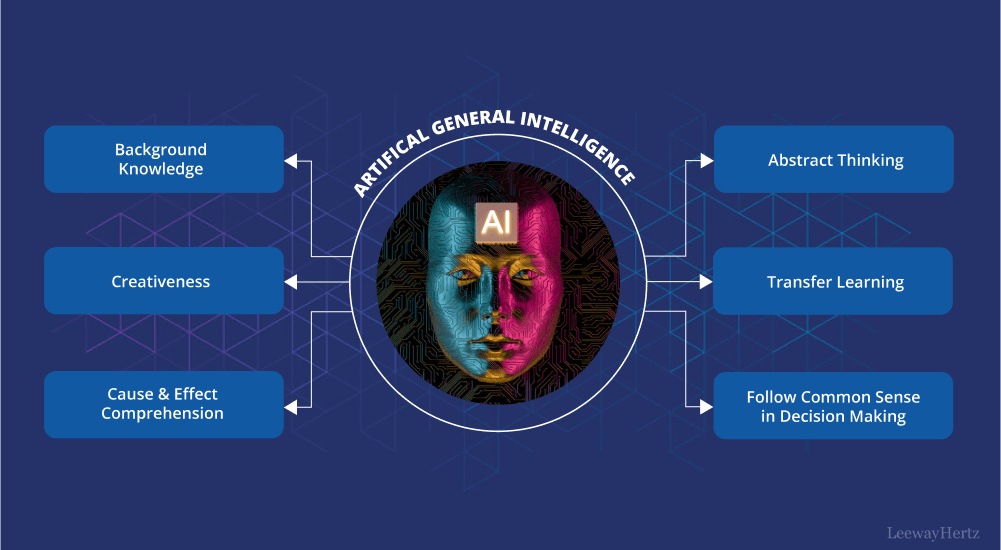
AGI refers to a type of artificial intelligence that possesses the ability to understand, learn, and apply knowledge across a wide range of tasks at a level comparable to human cognitive abilities. This includes reasoning, problem-solving, abstract thinking, and learning from experience.
The Current State of AI
Today’s AI systems are predominantly specialised or narrow AI. These systems excel at specific tasks such as image recognition, language translation, or playing complex games like chess and Go. However, they lack the flexibility and generalisation capabilities inherent in human intelligence.
The Challenges of Developing AGI
Developing AGI poses several challenges:
- Cognitive Architecture: Designing an architecture that can mimic human-like understanding and learning is complex and requires breakthroughs in neuroscience and cognitive science.
- Computation Power: AGI will likely require immense computational resources to process information similarly to the human brain.
- Ethical Considerations: As AGI approaches human-level capabilities, ethical considerations around safety, control, and impact on society become paramount.
The Potential Impact of AGI
If realised, AGI could revolutionise various sectors:
- Healthcare: Providing personalised medicine by understanding complex biological systems at a deeper level.
- Education: Offering tailored learning experiences that adapt to individual needs and learning styles.
- Agriculture: Optimising food production through advanced data analysis and predictive modelling.
The Road Ahead
The journey towards achieving AGI is filled with both excitement and uncertainty. While significant progress has been made in narrow AI applications, reaching true general intelligence remains an ambitious goal for researchers worldwide. Collaboration among disciplines such as computer science, neuroscience, ethics, and philosophy will be essential in shaping the future of AGI.
Conclusion
The pursuit of Artificial General Intelligence represents one of humanity’s most ambitious scientific endeavours. Its potential benefits are vast but must be approached with caution and responsibility. As we stand on the brink of this technological frontier, ongoing research and dialogue will play crucial roles in ensuring that AGI develops safely and beneficially for all.
Potential Benefits of Artificial General Intelligence: Transforming Problem-Solving, Research, Education, and More
- Could help solve complex problems across many fields.
- May accelerate scientific research and discovery.
- Could support more personalised education.
- May improve healthcare decision-making.
- Could automate a wider range of repetitive tasks.
- May help people make sense of large amounts of information.
- Could assist with creative and technical work.
- May enable more flexible, useful digital assistants.
Challenges of Artificial General Intelligence: Job Displacement, Unpredictable Decisions, and Potential Misuse
- Could displace workers across many industries.
- May make decisions that are difficult to understand or control.
- Could be misused or behave unpredictably.
Could help solve complex problems across many fields.
Artificial general intelligence could help tackle complex problems across a wide range of fields by combining knowledge, spotting patterns and adapting its approach to new challenges. It might support researchers in areas such as medicine, climate science and engineering, where problems often involve large amounts of data and interconnected factors. By helping people explore possible solutions more quickly, AGI could accelerate discovery and inform better decisions—while remaining a tool that requires human oversight and judgement.
May accelerate scientific research and discovery.
Artificial general intelligence could accelerate scientific research by helping researchers analyse vast datasets, identify patterns and generate hypotheses more quickly than traditional methods allow. It may also support complex simulations and connect insights across different disciplines, helping scientists explore promising ideas and design experiments more efficiently. Used alongside human expertise, AGI could shorten the time between a research question and a useful discovery, potentially speeding progress in areas such as medicine, climate science and materials research.
Could support more personalised education.
Artificial general intelligence could support more personalised education by adapting lessons to each learner’s knowledge, pace and preferred ways of engaging with material. It could identify areas where a student needs extra help, offer suitable explanations and exercises, and adjust its approach as their understanding develops. Used alongside teachers, this flexibility could help learners build confidence and make education more responsive to individual needs.
May improve healthcare decision-making.
Artificial general intelligence could improve healthcare decision-making by helping clinicians analyse large volumes of medical records, research and test results quickly. By identifying patterns and highlighting possible diagnoses or treatment options, it may support more informed, personalised care. AGI would not replace professional judgement; its recommendations would need careful evaluation by qualified healthcare staff to ensure decisions are safe, appropriate and suited to each patient.
Could automate a wider range of repetitive tasks.
Artificial general intelligence could automate a much wider range of repetitive tasks than today’s specialised systems. Because it could learn and adapt across different activities, it might handle routine work that varies from one situation to another, such as organising information, processing standard requests or updating records. This could save time, reduce the burden of repetitive work and allow people to focus on tasks requiring creativity, judgement and personal interaction.
May help people make sense of large amounts of information.
Artificial general intelligence could help people make sense of vast amounts of information by identifying patterns, connecting ideas and summarising complex material. This may make it easier to compare evidence, spot relevant insights and reach informed decisions in fields such as healthcare, research and education. Rather than replacing human judgement, a well-designed system could help people navigate information more quickly and focus their attention on what matters most.
Could assist with creative and technical work.
Artificial general intelligence could support people across a wide range of creative and technical work, from exploring ideas and drafting designs to analysing complex data and helping solve engineering problems. By adapting to different tasks and combining information from multiple fields, it could help individuals and teams work more efficiently, test possibilities and develop new approaches. Used as a tool rather than a replacement for human judgement, AGI could free people to focus on the decisions, relationships and original thinking that matter most.
May enable more flexible, useful digital assistants.
Artificial general intelligence could make digital assistants far more flexible and useful by helping them understand context, learn from experience and handle a wider range of tasks. Rather than following narrow commands, an advanced assistant might help plan a journey, compare options, organise a schedule and adapt its suggestions as circumstances change. This could make everyday technology feel more natural and reduce the effort needed to manage routine tasks, although such systems would need strong safeguards to protect users’ privacy and ensure their decisions remain reliable.
Could displace workers across many industries.
One potential drawback of artificial general intelligence is its ability to displace workers across many industries. Because AGI could learn and carry out a wide range of tasks, it may automate not only routine work but also roles that require analysis, communication or decision-making. This could reduce demand for some jobs and leave workers facing unemployment or the need to retrain, while the benefits of increased productivity may not be shared equally. Preparing for these changes through education, reskilling and thoughtful employment policies will be important.
May make decisions that are difficult to understand or control.
A potential drawback of artificial general intelligence is that its decisions may be difficult for people to understand or control. If an AGI system reaches a conclusion through complex processes that are not transparent, it may be hard to explain why it acted in a particular way or to spot errors before they cause harm. This could make accountability challenging, especially in high-stakes areas such as healthcare, finance or public services. Careful testing, clear oversight and reliable ways to intervene would therefore be essential.
Could be misused or behave unpredictably.
One potential drawback of artificial general intelligence is that it could be misused or behave in unpredictable ways. A system capable of carrying out a wide range of tasks might be exploited for harmful purposes, while errors in its design, training or instructions could lead to unintended outcomes. Because AGI could operate at great speed and scale, even a small mistake might have serious consequences, making careful testing, safeguards and human oversight essential.