
What Is an AI Website? Benefits, Features and Practical Uses
An AI website uses artificial intelligence to help create, manage or improve an online experience. This might mean a website built with an AI-powered design tool, or a site that uses AI features such as chatbots, personalised recommendations and intelligent search.
For businesses, the value lies in solving practical problems: helping visitors find information, reducing repetitive tasks and making online services easier to use. The most effective approach starts with a clear business need rather than adding AI simply because the technology is available.
AI Website Builders vs AI-Powered Websites
Although the terms are often used interchangeably, there is an important difference between an AI website builder and an AI-powered website.
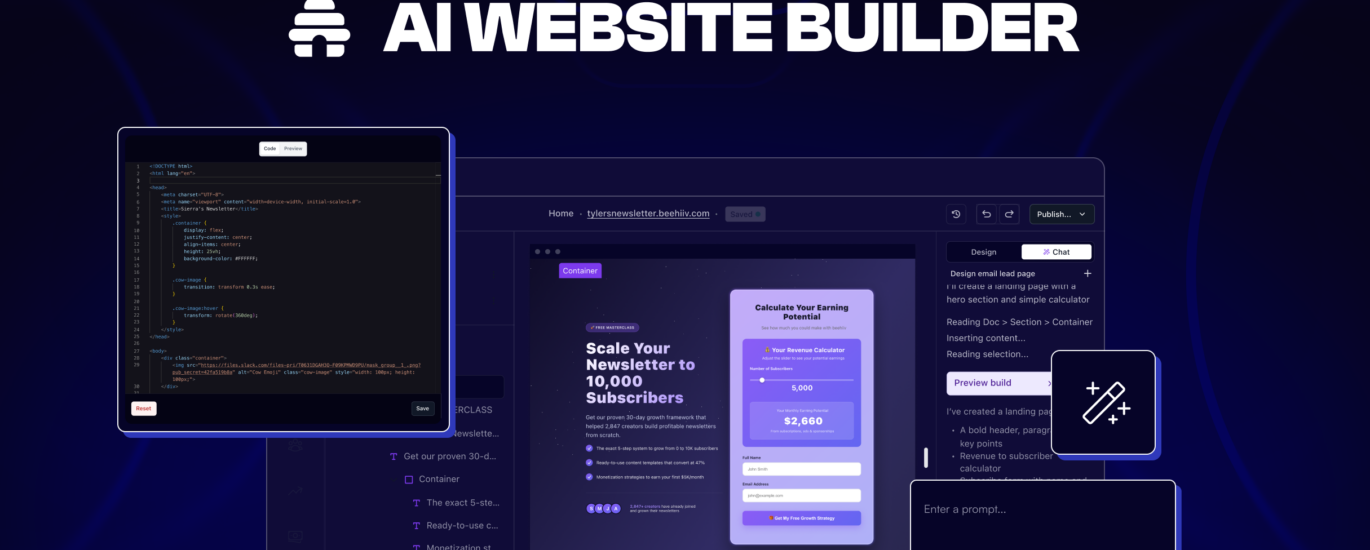
An AI website builder helps produce a website from prompts, business details or existing content. Depending on the platform, it may generate page layouts, suggest images, draft text and apply a consistent visual style. This can speed up the initial build, particularly for straightforward business websites.
An AI-powered website uses artificial intelligence as part of its ongoing functionality. Examples include an online shop that recommends relevant products or a support portal that answers questions using approved help articles.
A website can use either approach, or combine both.
Common Features of an AI Website
Conversational Support
AI chatbots can answer common questions, explain services and direct visitors to relevant pages. When connected to accurate, up-to-date business information, they can make routine support more accessible. Visitors should still have a clear route to human assistance when a question is complex or sensitive.
Intelligent Search
AI-powered search can interpret the intent behind a query rather than relying only on exact keyword matches. This can help visitors find useful information even when they do not know the terminology used on the website.
Personalised Recommendations
Retailers and content publishers can use AI to suggest products or articles based on relevant signals, such as browsing activity or stated preferences. Personalisation should be transparent and respect users’ privacy choices.
Content Assistance
AI tools can help draft product descriptions, summarise longer pages and suggest clearer wording. Human review remains essential to check accuracy, originality, tone and any claims about products or services.
What Are the Benefits?
A well-designed AI website can reduce the effort required to complete common tasks. Visitors may find answers more quickly, while staff spend less time responding to repetitive enquiries.
AI can also support website maintenance by helping organise content and identify areas that need attention. For smaller teams, this assistance may free up time for customer service, product development and other priorities.
However, results depend on the quality of the implementation. An inaccurate chatbot or an intrusive recommendation system can create more frustration than value.
Important Considerations Before Adding AI
- Accuracy: AI can produce incorrect or misleading answers. Use reliable information sources, test realistic scenarios and define when the system should decline to answer.
- Privacy: Understand what data is collected, where it is processed and how long it is retained. UK businesses should assess their obligations under the UK GDPR and other applicable rules.
- Security: Restrict access to sensitive information and test how AI features respond to attempts to manipulate their behaviour.
- Accessibility: Ensure AI tools work with assistive technologies and do not become the only way to access essential information.
- Cost: Consider ongoing usage charges, integration work, monitoring and maintenance as well as the initial development cost.
How to Get Started
Begin with one measurable problem. For example, a business receiving frequent delivery enquiries could introduce an assistant that answers questions from its published delivery policy.
Set a baseline before launch, then monitor measures such as answer accuracy, successful task completion, customer satisfaction and requests for human support. Expand only when the feature demonstrates a clear benefit.
A Better Website Starts with a Clear Purpose
An AI website should be useful before it is impressive. Strong content, accessible design, fast performance and straightforward navigation remain essential. Applied thoughtfully, AI can strengthen those foundations and help a website serve both its visitors and the business behind it.
AI Websites: Frequently Asked Questions About Types, Free Tools and ChatGPT Alternatives
- What AI is better than ChatGPT?
- What are 4 types of AI?
- Is there a free AI website?
- Is there an AI website?
- What are good AI websites?
What AI is better than ChatGPT?
No single AI tool is better than ChatGPT for every task; the best choice depends on the intended use. Claude is an alternative for writing and analysing documents, Gemini may suit users working with Google services, and Perplexity focuses on web-based research with source links. For an AI website, compare tools based on response quality, integration options, privacy, speed and cost. Features and performance change frequently, so testing current versions against real requirements is more useful than relying on a single ranking.
What are 4 types of AI?
The four types of AI, when classified by functionality, are reactive machines, limited memory, theory of mind and self-aware AI. Reactive machines respond to current inputs without learning from past experiences, while limited-memory AI uses past information to inform decisions, as seen in many modern AI applications. Theory-of-mind AI would understand people’s beliefs, emotions and intentions, but remains an area of research. Self-aware AI would possess consciousness and an awareness of its own existence; it is entirely hypothetical and does not currently exist.
Is there a free AI website?
Yes, several platforms offer free AI website builders that can generate a basic website from a short description of your business or project. Free plans typically include hosting and simple editing tools, but may display the provider’s branding, use a branded subdomain and limit storage or features. Connecting your own domain, accepting online payments or accessing more advanced tools often requires a paid subscription. Check whether the offer is a permanent free plan or a time-limited trial before getting started.
Is there an AI website?
Yes, there are many websites that use artificial intelligence, including ChatGPT for answering questions and drafting content, and Canva for AI-assisted design. If you mean an AI tool that builds websites, platforms such as Wix and Framer offer features that can generate layouts and content from a description of your business. The best option depends on what you want to achieve, your budget and how much control you need over the finished website.
What are good AI websites?
Good AI websites depend on the task you want to complete. ChatGPT, Claude and Google Gemini are useful for drafting content, exploring ideas and answering questions, while Perplexity offers AI-assisted search with links to sources. For creative work, Canva provides AI-powered design tools, and Adobe Firefly supports image generation and editing. If you want to build a website, Wix and Framer offer AI-assisted website creation. Compare features, pricing and privacy policies before choosing, and always check important AI-generated information for accuracy.