
How to Carry Out an SEO Analysis of a Web Page
A page can look polished and still struggle to appear in search results. An SEO analysis helps identify what is working, what may be holding a page back and which improvements are likely to make the biggest difference. It looks at the page’s content, technical setup and user experience, as well as how the page fits into the wider website.
Start with the page’s purpose
Before reviewing keywords or technical details, clarify what the page is meant to achieve. Is it designed to answer a question, explain a service, attract enquiries or support a purchase? A clear purpose makes it easier to assess whether the content meets visitors’ needs and whether its calls to action are appropriate.
Consider the intended audience and the search queries that might lead them to the page. The aim is not simply to attract more visits, but to attract people who are likely to find the page useful.
Review the title tag and meta description
The title tag helps search engines and visitors understand what a page is about. It should be unique, accurate and specific to the page. Where appropriate, include the main topic naturally, while keeping the wording clear and appealing.
The meta description is a short summary that may appear beneath the page title in search results. It is not a direct ranking factor, but a relevant description can encourage people to click. Avoid writing a list of keywords; instead, explain what the visitor will find on the page.
Check the headings and content
A well-structured page is easier to read and understand. Use one clear main heading to introduce the topic, followed by descriptive subheadings that organise the information into useful sections. Headings should reflect the content beneath them rather than being chosen solely to include keywords.
Review the text for accuracy, clarity and completeness. Does it answer the questions a visitor is likely to have? Is it original and specific, or does it repeat information already available elsewhere? Useful content should provide genuine value, demonstrate relevant knowledge and make the next step clear.
Keywords can help describe a page’s subject, but they should fit naturally into the writing. Repeating the same phrase excessively can make content awkward and unhelpful. Consider related terms and questions that people may use when searching for the topic.
Assess internal and external links
Internal links connect the page to other relevant parts of your website. They help visitors discover related information and help search engines understand how your pages relate to one another. Use descriptive link text so people know what to expect when they follow a link.
Check that links work, lead to relevant destinations and are not included simply for the sake of adding links. If the page refers to external research or guidance, linking to trustworthy sources can help readers verify information.
Examine images and other media
Images, video and other media can make a page more engaging, but they should support its purpose. Check that images are relevant, display correctly and are appropriately sized. Large files can slow a page down, so compressing images and using suitable formats can help improve performance.
Write alternative text for images that convey meaningful information. Alt text should describe the image’s purpose in context; decorative images can generally use empty alt text so assistive technology can skip them.
Review technical SEO
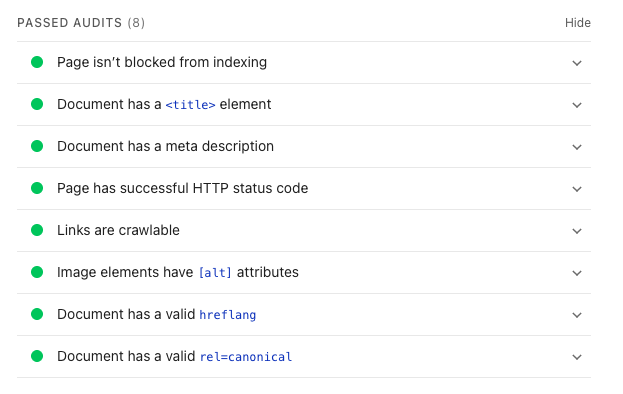
Technical checks help ensure that search engines can access and understand the page. Confirm that the page loads over HTTPS, returns the correct status code and is not accidentally blocked from indexing. If the page has a preferred version, check that its canonical tag points to the correct URL.
Also review the page on mobile devices. Text should be readable without unnecessary zooming, interactive elements should be easy to use, and the layout should adapt to different screen sizes.
Check speed and usability
A page that loads slowly or is difficult to use can frustrate visitors. Test its performance using tools such as Google PageSpeed Insights, then investigate the recommendations that are relevant to the page. Common improvements include reducing large image files, limiting unnecessary scripts and improving how content loads.
Usability matters too. Check that navigation is clear, buttons and forms work, and the page does not contain intrusive pop-ups or confusing layouts. A good experience helps visitors complete the task they came to do.
Use data to guide improvements
SEO analysis should include more than a one-off review. Tools such as Google Search Console can show which search queries lead to impressions and clicks, while analytics platforms can help reveal how visitors interact with the page.
Look for patterns rather than relying on a single metric. For example, a page may receive many impressions but few clicks, suggesting that its search result title or description could be improved. A high exit rate is not automatically a problem: visitors may have found the answer they needed. Interpret performance in the context of the page’s purpose.
Prioritise the changes
An analysis may uncover several opportunities, but not all require immediate attention. Start with issues that prevent access or indexing, followed by problems that significantly affect the page’s accuracy, usefulness or usability. Then consider improvements to headings, internal links, metadata and supporting media.
After making changes, monitor the page over time. Search performance can fluctuate, and improvements may not be reflected immediately. Keeping a record of changes makes it easier to understand what has helped.
A practical SEO analysis checklist
- The page has a clear purpose and serves a defined audience.
- The title tag and meta description are accurate and distinctive.
- The main heading and subheadings organise the content logically.
- The content is useful, current, original and easy to understand.
- Keywords and related terms are used naturally.
- Internal and external links are relevant and working.
- Images are optimised and have appropriate alternative text.
- The page can be crawled and indexed as intended.
- The page works well on mobile devices and loads promptly.
- Performance is reviewed using relevant search and analytics data.
Conclusion
An SEO analysis of a page is a practical way to improve its visibility and usefulness. By reviewing content, metadata, links, technical setup, speed and user experience, website owners can identify changes that support both search engines and visitors. Regular reviews help keep pages accurate, relevant and aligned with the needs of their audience.
On-Page SEO Analysis: 14 Frequently Asked Questions for 2026
- What is good on page SEO score?
- How do you Analyse a website page?
- How to do a SEO analysis?
- What is the SEO analysis of a page?
- How do you analyze on-page SEO?
- How do you analyze SEO content?
- What’s SEO analysis?
- How to do SEO analysis?
- How to check the SEO of a page?
- What is on-page analysis?
- What are the top 5 on page SEO factors?
- What is SEO analysis of content?
- What is meant by SEO analysis?
- Is SEO dead or evolving in 2026?
What is good on page SEO score?
There is no single “good” on-page SEO score, as scoring tools use different criteria and weight them differently. A high score can be a useful indicator that basics such as titles, headings, content and links have been checked, but it does not guarantee strong rankings or traffic. Focus on making the page helpful, relevant and easy to use, and treat any SEO score as a guide to possible improvements rather than a definitive measure of success.
How do you Analyse a website page?
To analyse a website page, start by checking its purpose and whether its content meets the needs of its intended audience. Review the title tag, meta description, headings, keywords and internal links, then assess the content for accuracy, clarity and usefulness. Check that search engines can crawl and index the page, and test its mobile usability, loading speed and accessibility. Finally, use tools such as Google Search Console and analytics platforms to review impressions, clicks and visitor behaviour, then prioritise improvements based on their likely impact.
How to do a SEO analysis?
To carry out an SEO analysis, review the page’s purpose, target search terms, title tag, meta description, headings and content to check that they are relevant, clear and useful to visitors. Then assess technical factors, including whether the page can be crawled and indexed, its mobile usability, loading speed and secure connection. Check that internal and external links work, and use tools such as Google Search Console and an analytics platform to monitor impressions, clicks and visitor behaviour. Prioritise fixes that affect access, accuracy or user experience, then track performance after making changes.
What is the SEO analysis of a page?
SEO analysis of a page is the process of reviewing its content, structure and technical settings to understand how well it is optimised for search engines and visitors. It typically checks elements such as the page title, headings, keywords, links, images, loading speed, mobile usability and indexability. The aim is to identify issues and opportunities, then make improvements that help the page appear in relevant search results and provide a better experience for users.
How do you analyze on-page SEO?
To analyse on-page SEO, review whether the page clearly matches its intended search topic and meets visitors’ needs. Check the title tag, meta description, main heading and subheadings, then assess the content for relevance, usefulness, accuracy and natural use of keywords. Also inspect internal links, image alt text, URL structure, mobile usability, loading speed and technical settings such as indexing and canonical tags. Use tools such as Google Search Console and analytics reports to see how the page performs in search, and prioritise improvements based on their likely impact.
How do you analyze SEO content?
To analyse SEO content, check that it clearly answers the audience’s search intent and provides accurate, useful and original information. Review the page title, meta description, headings and URL, and make sure relevant keywords and related terms appear naturally rather than being repeated unnaturally. Assess readability, structure, freshness, internal and external links, and whether images have descriptive alt text. Finally, use tools such as Google Search Console and analytics platforms to review impressions, clicks, rankings and visitor behaviour, then prioritise improvements based on the page’s purpose and performance.
What’s SEO analysis?
SEO analysis is the process of reviewing a web page to understand how well it is optimised for search engines and visitors. It can include checks on content, keywords, headings, page titles, links, loading speed, mobile usability and technical settings such as indexing. The aim is to identify what is working and what could be improved to help the page appear in relevant search results and provide a better experience for users.
How to do SEO analysis?
To carry out an SEO analysis, review the page’s purpose, target audience and search terms, then check its title tag, meta description, headings and content for relevance, clarity and accuracy. Make sure internal links work, images are optimised, and the page is mobile-friendly, secure, quick to load and accessible to search engines. Tools such as Google Search Console and PageSpeed Insights can help identify issues and track performance. Prioritise changes that improve usefulness and usability, then monitor results over time.
How to check the SEO of a page?
To check the SEO of a page, review its title tag, meta description, headings and content to ensure they are clear, relevant and useful to your audience. Check that the page loads quickly, works well on mobile devices, uses descriptive links and image alt text, and can be crawled and indexed by search engines. Tools such as Google Search Console and PageSpeed Insights can help identify technical issues and show how the page performs in search. Fix the most important problems first, then monitor results over time.
What is on-page analysis?
On-page analysis is the process of reviewing the elements on a web page to assess how well it is optimised for search engines and visitors. It typically covers the page’s content, title tag, meta description, headings, keywords, internal links, images, mobile usability and loading speed. The aim is to identify practical improvements that make the page clearer, more useful and easier for search engines to understand.
What are the top 5 on page SEO factors?
The top five on-page SEO factors are high-quality, relevant content; a clear title tag that accurately describes the page; a logical heading structure; a concise, compelling meta description; and a well-organised URL that reflects the page topic. It is also important to use relevant search terms naturally, link to related pages on your website, and ensure the page is fast, mobile-friendly and easy to navigate. These elements help search engines understand the content while giving visitors a better experience.
What is SEO analysis of content?
SEO analysis of content is the process of assessing how well a webpage’s text and other media meet the needs of its audience and support its visibility in search results. It involves checking whether the content is relevant, accurate, useful, clearly structured and easy to read, as well as reviewing headings, keywords, links, images and freshness. The aim is to identify practical improvements that make the page more helpful to visitors and easier for search engines to understand.
What is meant by SEO analysis?
SEO analysis is the process of reviewing a web page or website to understand how well it is optimised for search engines and how easily people can find and use it. It typically examines factors such as content quality, keywords, page titles, headings, links, loading speed, mobile usability and whether search engines can access and index the page. The findings help identify improvements that could increase relevant organic traffic and provide a better experience for visitors.
Is SEO dead or evolving in 2026?
No—SEO is not dead in 2026; it is evolving as search engines develop and people increasingly use AI-powered search tools. The fundamentals still matter: useful, trustworthy content, a technically sound website and a good experience for visitors. What is changing is the need to make content clear, distinctive and easy for both people and search systems to understand, while measuring visibility beyond traditional rankings. A page-level SEO analysis should therefore review not only keywords and links, but also accuracy, expertise, usability, accessibility and how well the page answers its audience’s needs.