

Understanding Artificial Intelligence, Machine Learning, and Deep Learning
In recent years, the terms artificial intelligence (AI), machine learning (ML), and deep learning have become ubiquitous in discussions about technology and its future. While often used interchangeably, these concepts are distinct yet interconnected components of modern computing. This article aims to clarify their meanings and explore their applications.
Artificial Intelligence: The Broad Concept
Artificial intelligence is the overarching field that encompasses any technique enabling machines to mimic human intelligence. AI aims to create systems capable of performing tasks that would typically require human intellect, such as understanding natural language, recognising patterns, solving problems, and making decisions.
The concept of AI has been around since the mid-20th century, evolving from simple rule-based systems to more sophisticated models capable of learning from data. Today, AI is embedded in various applications ranging from virtual assistants like Siri and Alexa to autonomous vehicles.
Machine Learning: The Pathway to AI
Machine learning, a subset of AI, focuses on developing algorithms that enable computers to learn from data without explicit programming. Instead of following predefined rules, ML systems improve their performance by identifying patterns in data sets.
The process involves training a model on a large amount of data so it can make predictions or decisions based on new inputs. Common applications include recommendation engines used by streaming services like Netflix and Spotify or fraud detection systems employed by financial institutions.
Deep Learning: The Cutting Edge of ML
Deep learning, a specialised branch of machine learning, utilises neural networks with many layers—hence the term “deep”—to analyse complex patterns in vast amounts of data. These neural networks are inspired by the structure and function of the human brain’s neurons.
This approach has revolutionised fields such as image and speech recognition. For example, deep learning algorithms power facial recognition technology in social media platforms and enable real-time language translation through services like Google Translate.
The Interplay Between AI, ML, and Deep Learning
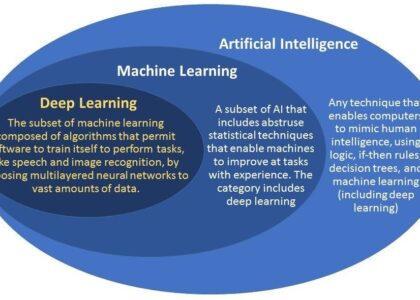
The relationship between these three technologies can be visualised as concentric circles: deep learning is a subset within machine learning, which is itself a subset within artificial intelligence. Each layer builds upon the previous one to create increasingly sophisticated systems capable of tackling complex tasks.
This synergy has led to remarkable advancements across various industries. In healthcare, for example, AI-driven tools assist doctors in diagnosing diseases with greater accuracy by analysing medical images or patient histories through deep learning models.
The Future Outlook
The potential for artificial intelligence continues to expand as researchers develop more advanced algorithms and computational power increases. As these technologies evolve further into everyday life—from smart homes equipped with intelligent devices to personalised education platforms—their impact will be profound.
However, ethical considerations must accompany this growth trajectory; ensuring transparency in decision-making processes while addressing concerns about privacy rights remains paramount for responsible development moving forward.
Conclusion
The journey from artificial intelligence through machine learning down into deep learning represents an exciting frontier at the intersection between computer science innovation & societal transformation worldwide today—and tomorrow’s possibilities seem boundless yet challenging too!
Understanding AI, Machine Learning, and Deep Learning: Key Questions and Insights
- What is artificial intelligence?
- How does machine learning differ from artificial intelligence?
- What are the applications of machine learning in real-world scenarios?
- What is deep learning and how does it relate to machine learning?
- How are artificial intelligence, machine learning, and deep learning used in industries such as healthcare and finance?
- What are the benefits of implementing artificial intelligence technologies in businesses?
- Are there ethical concerns associated with the use of AI, ML, and DL?
- What skills are required to work in the field of artificial intelligence and machine learning?
- How can individuals stay updated on the latest developments in AI, ML, and DL?
What is artificial intelligence?
When exploring the realm of technology, a frequently asked question is, “What is artificial intelligence?” Artificial intelligence refers to the capability of machines to simulate human intelligence, enabling them to perform tasks that typically require human cognition. This field encompasses a wide range of applications, from automated decision-making and natural language processing to image recognition and autonomous driving. By leveraging algorithms and data, artificial intelligence enables machines to learn from experience, adapt to new inputs, and execute tasks with precision. In essence, artificial intelligence represents the pinnacle of technological innovation, offering boundless opportunities for enhancing efficiency and transforming industries across the globe.
How does machine learning differ from artificial intelligence?
When exploring the distinction between machine learning and artificial intelligence, it is essential to understand that machine learning is a subset of artificial intelligence. While artificial intelligence encompasses a broader concept of creating systems that mimic human intelligence to perform various tasks, machine learning specifically focuses on developing algorithms that enable computers to learn from data without explicit programming. In essence, machine learning is a technique within the realm of artificial intelligence that empowers systems to improve their performance by identifying patterns in data sets through training. This distinction highlights how machine learning serves as a pathway towards achieving artificial intelligence’s goal of creating intelligent systems capable of autonomous decision-making and problem-solving.
What are the applications of machine learning in real-world scenarios?
One frequently asked question regarding artificial intelligence, machine learning, and deep learning is: “What are the applications of machine learning in real-world scenarios?” Machine learning has a wide range of practical applications across various industries. In real-world scenarios, machine learning is used for tasks such as predictive analytics in finance to detect fraudulent transactions, personalised recommendations on streaming platforms like Netflix, improving healthcare outcomes through predictive diagnostics, optimising supply chain management for businesses, and enhancing customer experience by analysing data to tailor services. These applications demonstrate the versatility and impact of machine learning in solving complex problems and driving innovation across different sectors.
What is deep learning and how does it relate to machine learning?
Deep learning is a specialised subset of machine learning that focuses on using neural networks with multiple layers to analyse and interpret complex data patterns. Inspired by the human brain’s structure, these neural networks enable computers to learn from vast amounts of data, making it possible to recognise intricate patterns and features. While machine learning involves training algorithms to make predictions or decisions based on input data, deep learning takes this a step further by allowing models to automatically discover representations needed for feature detection or classification. This capability makes deep learning particularly effective in areas such as image and speech recognition, where understanding nuanced details is crucial. In essence, deep learning enhances machine learning by providing powerful tools for handling large-scale and unstructured data, thereby expanding the potential applications of artificial intelligence.
How are artificial intelligence, machine learning, and deep learning used in industries such as healthcare and finance?
Artificial intelligence, machine learning, and deep learning have revolutionised industries like healthcare and finance by offering powerful tools for data analysis, decision-making, and automation. In healthcare, these technologies are utilised to enhance diagnostic accuracy, predict patient outcomes, and streamline administrative processes. Machine learning algorithms can analyse vast amounts of medical data to identify patterns that help in early disease detection and personalised treatment plans. Additionally, deep learning models are employed in medical imaging interpretation, enabling faster and more accurate diagnoses. In the financial sector, AI-driven systems are used for fraud detection, risk assessment, algorithmic trading, and customer service automation. Machine learning algorithms can analyse market trends to make informed investment decisions, while deep learning models enhance cybersecurity measures by detecting anomalies in transactions. Overall, artificial intelligence technologies play a crucial role in improving efficiency, accuracy, and decision-making processes across various sectors within healthcare and finance.
What are the benefits of implementing artificial intelligence technologies in businesses?
Implementing artificial intelligence technologies in businesses offers numerous benefits that can significantly enhance operational efficiency and drive innovation. AI can automate routine tasks, freeing up employees to focus on more strategic activities, which leads to increased productivity. Machine learning algorithms enable businesses to analyse vast amounts of data quickly and accurately, providing valuable insights that inform decision-making processes and improve customer experiences. Deep learning, with its advanced pattern recognition capabilities, allows for more precise predictive analytics, enhancing everything from supply chain management to marketing strategies. Additionally, AI technologies can personalise customer interactions at scale, fostering stronger customer relationships and boosting satisfaction. Overall, the integration of AI into business processes not only streamlines operations but also positions companies to remain competitive in an increasingly digital landscape.
Are there ethical concerns associated with the use of AI, ML, and DL?
Yes, there are significant ethical concerns associated with the use of artificial intelligence (AI), machine learning (ML), and deep learning (DL). These technologies, while offering transformative potential, raise issues around privacy, bias, and accountability. AI systems often rely on vast amounts of data, which can include sensitive personal information, leading to privacy concerns if not managed properly. Additionally, ML and DL models can inadvertently perpetuate or even exacerbate existing biases present in training data, resulting in unfair or discriminatory outcomes. Furthermore, as these systems become more autonomous and complex, determining accountability for their decisions poses a challenge. Ensuring transparency in AI processes and implementing robust ethical guidelines are essential to address these concerns effectively.
What skills are required to work in the field of artificial intelligence and machine learning?
Working in the field of artificial intelligence (AI) and machine learning (ML) requires a diverse set of skills that blend technical expertise with analytical thinking. A strong foundation in mathematics, particularly in linear algebra, calculus, and statistics, is essential for understanding the algorithms that drive AI and ML models. Proficiency in programming languages such as Python or R is crucial for implementing these algorithms effectively. Additionally, knowledge of data structures and software engineering principles is important for developing scalable solutions. Familiarity with machine learning frameworks like TensorFlow or PyTorch can be advantageous. Beyond technical skills, critical thinking and problem-solving abilities are vital for designing innovative solutions to complex challenges. Furthermore, staying updated with the latest advancements through continuous learning is key to thriving in this rapidly evolving field.
How can individuals stay updated on the latest developments in AI, ML, and DL?
Staying updated on the latest developments in artificial intelligence (AI), machine learning (ML), and deep learning (DL) requires a proactive approach, given the rapid pace of advancements in these fields. Individuals can begin by subscribing to reputable online publications and journals such as MIT Technology Review, Wired, or AI-specific platforms like Towards Data Science. Engaging with academic papers on platforms like arXiv can also provide insights into cutting-edge research. Additionally, participating in webinars, online courses, and workshops offered by leading universities and tech companies can enhance understanding and practical skills. Joining online communities and forums such as Reddit’s r/MachineLearning or LinkedIn groups allows for networking with professionals and enthusiasts who share the latest trends and breakthroughs. Lastly, attending conferences and industry events provides opportunities to hear directly from experts and see innovations firsthand.